



Due to its unique molecular structure, PTFE is chemically inert, non-reactive, and highly durable, making it ideal for use in demanding industrial environments such as chemical processing, food and pharmaceutical manufacturing, electronics, oil & gas, and automotive systems. PTFE is widely used in the form of sheets, rods, tubes, gaskets, seals, and custom-machined components.
In modern manufacturing, PTFE is critical because it enables long service life, operational safety, and consistent performance in applications where other materials fail, particularly under high temperatures, corrosive chemicals, mechanical stress, and strict hygiene requirements.
PTFE stands for Polytetrafluoroethylene, a synthetic fluoropolymer made up of repeating tetrafluoroethylene units. The name reflects its chemical structure, where carbon atoms form a strong backbone that is fully surrounded by fluorine atoms.
What Does PTFE Stand For?
This molecular structure is the key to PTFE’s exceptional performance. The carbon–fluorine (C–F) bonds are among the strongest in organic chemistry, creating a highly stable and protective fluorine “shield” around the carbon chain. As a result, PTFE is extremely resistant to chemical reactions, heat, and degradation.
Because of this unique structure, PTFE exhibits properties such as chemical inertness, very low friction, high-temperature resistance, excellent electrical insulation, and long-term durability, making it one of the most reliable materials for demanding industrial and manufacturing applications.
Brief History of PTFE
PTFE was discovered in 1938 by chemist Roy J. Plunkett during research on fluorinated refrigerants. The material’s unusual properties, particularly its chemical inertness and heat resistance, quickly attracted attention for industrial use.
In the 1940s, PTFE was adopted for critical applications, including sealing and lining components in chemical processing and defense-related industries, where conventional materials failed under extreme conditions. Its reliability in harsh environments led to wider industrial acceptance in the following decades.
Today, PTFE has evolved into a highly refined, industrial-grade material, available in multiple grades, filled compounds, and precision-machined forms. Advances in processing techniques now allow manufacturers to produce PTFE components with tight tolerances, consistent quality, and performance tailored to modern manufacturing, engineering, and regulatory requirements.
How PTFE Is Manufactured
PTFE is manufactured through a controlled polymerization process in which tetrafluoroethylene (TFE) monomers are chemically bonded to form a solid fluoropolymer resin. This process creates PTFE in a fine powder or granular form, which is then processed into usable industrial materials. Due to its extremely high melting point and viscosity, PTFE cannot be processed like conventional plastics.
Instead, PTFE is shaped using specialized manufacturing methods. Common techniques include compression molding, where PTFE resin is pressed into solid forms; Ram or paste extrusion, used to produce rods and tubes; and skiving, a precision process where thin sheets are cut from molded PTFE billets. These methods allow manufacturers to produce PTFE sheets, rods, tubes, and semi-finished products with consistent quality.
Modern PTFE manufacturing combines precise temperature control, pressure management, and quality inspection to ensure material purity, dimensional stability, and performance reliability. This level of process control is essential for producing PTFE components that meet demanding industrial, regulatory, and application-specific requirements.
PTFE Raw Materials
The primary raw material for PTFE is tetrafluoroethylene (TFE), a fluorinated monomer that polymerizes to form the fluoropolymer PTFE. The quality of the resulting PTFE largely depends on the purity of the resin and the manufacturing controls during polymerization. High-quality PTFE resins produce materials with superior chemical resistance, mechanical stability, and thermal performance.
From a production perspective, PTFE is available in virgin and reprocessed grades:
- Virgin PTFE: Made from 100% new, high-purity TFE resin. Offers the highest level of chemical inertness, electrical insulation, mechanical strength, and long-term durability. It is preferred for critical industrial applications, such as food processing, pharmaceuticals, aerospace, and electronics.
- Reprocessed PTFE: Manufactured using recycled or re-milled PTFE material. While still chemically stable, reprocessed PTFE may have slightly lower mechanical performance or dimensional consistency. It is suitable for less demanding applications where cost-effectiveness is prioritized over maximum performance.
Selecting the right grade of PTFE raw material is essential to ensure that finished products meet application requirements, regulatory standards, and long-term performance expectations, particularly in demanding industrial environments.
Common PTFE Processing Methods
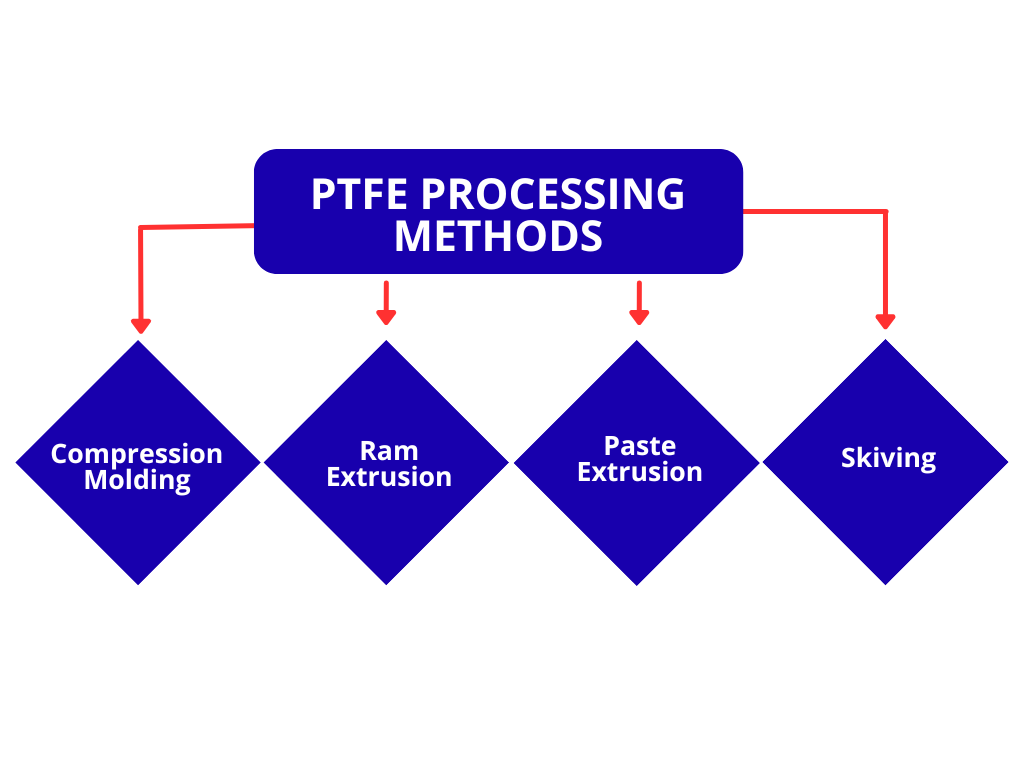
PTFE’s unique properties make it difficult to process like conventional thermoplastics, so specialized manufacturing techniques are used to shape it into sheets, rods, tubes, and other industrial components. The most common methods include:
1. Compression Molding
- PTFE powder or granular resin is placed into a mold and subjected to high pressure and heat.
- This method produces solid billets, sheets, and custom shapes with excellent dimensional stability.
- Ideal for large, high-performance components used in chemical processing or mechanical systems.
2. Ram Extrusion
- Commonly used for industrial rods, bushings, and tubing.
- PTFE powder is compressed into a cylindrical ram, which is then forced through a die to create rods, tubes, or hollow profiles.
- Provides uniform density and consistent mechanical properties.
3. Paste Extrusion
- PTFE powder is mixed with a small amount of lubricant to form a paste, which is then extruded through a die.
- After extrusion, the lubricant is removed, leaving a highly dense, machinable PTFE shape.
- Often used for tubes, films, and specialty profiles that require precise dimensions
4. Skiving
- Skiving allows for tight tolerances and smooth surfaces, critical for high-performance sealing applications.
- Thin PTFE sheets are sliced from a solid billet using precision blades.
- Produces uniform, thin sheets for gaskets, seals, and industrial liners.
Key Properties of PTFE
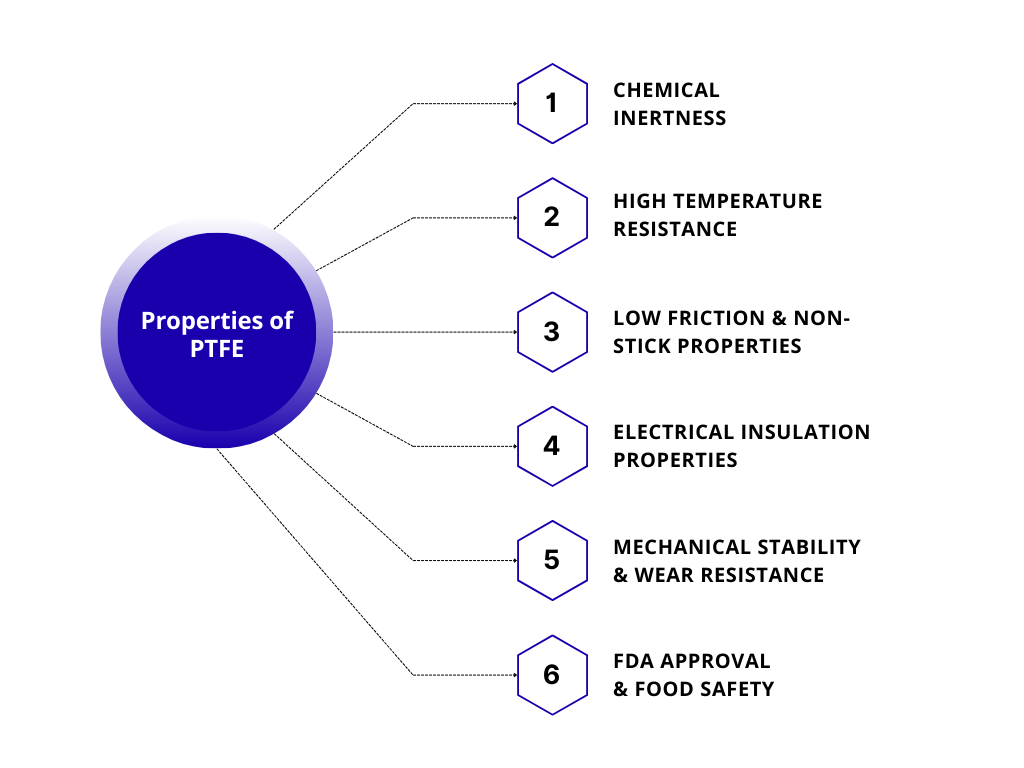
PTFE is widely regarded as one of the most versatile and reliable industrial plastics due to its combination of chemical, thermal, mechanical, and electrical properties. Its unique molecular structure allows it to perform consistently in harsh environments where many other materials would fail, making it ideal for a wide range of demanding industrial applications, from chemical processing to food and pharmaceutical manufacturing.
1. Chemical Inertness
2. High Temperature Resistance
3. Low Friction & Non-Stick Properties
4. Electrical Insulation Properties
5. Mechanical Stability & Wear Resistance
6. FDA Approval & Food Safety
Advantages of Using PTFE
PTFE offers a combination of high performance, long-term reliability, and cost-effectiveness, making it a preferred material for industrial applications. Its unique properties reduce operational risks, extend equipment life, and provide versatility across a wide range of demanding environments, helping businesses achieve lower lifecycle costs and higher process efficiency.
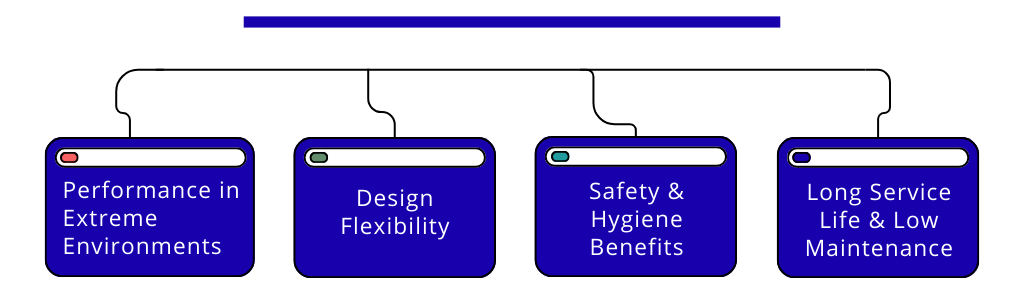
a. Performance in Extreme Environments
b. Design Flexibility
PTFE can be easily machined and formed into complex geometries, making it suitable for custom parts and precision components. Manufacturers can produce sheets, rods, tubes, gaskets, and intricate machined items tailored to specific industrial requirements. This flexibility allows engineers to design components that precisely meet operational needs.
c. Safety & Hygiene Benefits
Being non-toxic and chemically inert, PTFE is ideal for applications where hygiene and safety are critical. Its clean, non-stick surface prevents contamination and buildup of residues, making it perfect for food, pharmaceutical, and medical industries, as well as for any application requiring a safe and chemically stable material.
d. Long Service Life & Low Maintenance
PTFE components are extremely durable, reducing the need for frequent replacements or repairs. This minimizes downtime in production processes and lowers maintenance costs, delivering significant savings over the lifecycle of equipment. Industrial users benefit from reliable, long-lasting parts that maintain their performance over years of continuous operation.
Common Grades of PTFE
PTFE is available in different grades to meet the specific demands of various industrial applications. While pure PTFE offers excellent chemical resistance and electrical insulation, fillers such as glass, bronze, carbon, or stainless steel are added to enhance mechanical properties, wear resistance, thermal conductivity, or anti-static performance. Selecting the appropriate grade ensures that PTFE components perform optimally under the intended operating conditions.
a. Virgin PTFE
Virgin PTFE is made from 100% pure resin, providing the highest chemical resistance, exceptional electrical insulation, and maximum purity. It is ideal for critical applications in the chemical, food, pharmaceutical, and electronics industries, where material performance and compliance are essential.
b. Glass-Filled PTFE
Glass-filled PTFE incorporates fine glass fibers to improve wear resistance, stiffness, and dimensional stability. This grade is suitable for bearings, bushings, and sliding components that require reduced creep and enhanced mechanical strength while maintaining chemical resistance.
c. Bronze-Filled PTFE
Bronze-filled PTFE includes bronze particles, enhancing thermal conductivity and wear resistance. It is commonly used in high-load mechanical parts, such as bearings, valve components, and pumps, where heat dissipation and mechanical durability are critical.
d. Carbon-Filled PTFE
Carbon-filled PTFE provides improved wear resistance and anti-static properties while maintaining chemical inertness. It is often chosen for electronic components, sliding seals, and industrial machinery where static charge reduction and longevity are important.
e. Stainless Steel-Filled PTFE
This grade combines PTFE with stainless steel fibers to withstand extreme loads, high wear, and mechanical stress. It is suitable for heavy-duty industrial applications, including high-pressure seals, chemical processing equipment, and machinery components that demand superior strength and durability.
Forms and Availability of PTFE Products
PTFE is offered in a variety of semi-finished and finished forms to meet the diverse requirements of industrial applications. These forms include sheets, rods, tubes, gaskets, seals, and custom-machined components. By providing versatile product formats, manufacturers and engineers can select the most suitable PTFE solution for chemical, mechanical, electrical, and food-grade applications.
a. PTFE Sheets
PTFE sheets are available in various thicknesses and sizes, providing a durable, chemically resistant, and low-friction material for industrial use. They are commonly used in chemical processing equipment, lining systems, bearings, gaskets, and food-grade surfaces. Their dimensional stability and ability to be cut or machined make them ideal for both standard and custom applications.
b. PTFE Rods
PTFE rods can be machined into precise components such as bushings, bearings, pins, and structural parts. They are valued for their wear resistance, low friction, and chemical inertness, making them suitable for use in mechanical assemblies, industrial machinery, and chemical handling equipment.
c. PTFE Tubes
PTFE tubes are used in chemical transport, insulation, and fluid handling systems. They offer excellent resistance to corrosive substances, high temperatures, and non-stick surfaces, making them ideal for piping, instrumentation, and electrical insulation applications across multiple industries.
d. PTFE Seals & Gaskets
PTFE seals and gaskets provide leak-proof connections in chemical, pharmaceutical, and food processing equipment. They are designed to withstand high pressure, extreme temperatures, and aggressive chemicals, ensuring long-lasting performance and reliable sealing in critical applications.
e. Custom Machined PTFE Components
For applications requiring precise specifications, CNC-machined PTFE components can be manufactured according to custom drawings. These include specialized parts for OEMs, industrial machinery, and high-performance equipment, providing tailored solutions that meet unique operational and regulatory requirements.
Applications of PTFE Across Industries
PTFE’s unique combination of chemical resistance, thermal stability, low friction, and electrical insulation makes it a highly versatile material across multiple industries. Its ability to perform reliably under extreme conditions has led to widespread adoption in manufacturing, chemical processing, electronics, and more.
a. Chemical Processing Industry
PTFE is widely used for linings, pipes, valves, and gaskets in chemical plants due to its resistance to aggressive acids, bases, and solvents. Its inertness ensures long-term durability and protects equipment from corrosion, reducing maintenance and downtime in industrial operations.
b. Food & Beverage Industry
In the food and beverage sector, FDA-approved PTFE components are essential for hygiene and contamination prevention. Its non-stick and easy-to-clean surfaces make it ideal for conveyor systems, processing equipment, and food contact gaskets, ensuring compliance with strict food safety standards.
c. Pharmaceutical Industry
PTFE’s purity and chemical inertness make it suitable for pharmaceutical applications, where contamination prevention and regulatory compliance are critical. It is used in tubing, seals, linings, and custom components to maintain the integrity of sensitive products.
d. Oil & Gas Industry
In oil and gas operations, PTFE components such as seals, gaskets, and tubing perform reliably under high pressures, extreme temperatures, and corrosive environments. Its durability ensures safe, long-lasting performance in pipelines, refineries, and offshore installations.
e. Aerospace & Automotive
PTFE is valued in aerospace and automotive applications for its lightweight nature, thermal stability, and electrical insulation properties. It is used in fuel systems, hydraulic components, bearings, and insulation for wiring, providing performance and reliability under demanding operating conditions.
f. Electronics & Electrical Industry
PTFE provides excellent dielectric strength and insulation stability, making it ideal for wire insulation, connector, high-frequency cables, and other electrical components. Its chemical inertness and heat resistance ensure reliable performance in sensitive electronic and electrical systems.
Q: Is PTFE Safe?
PTFE is considered a safe and reliable material for industrial, food, pharmaceutical, and electrical applications when used according to manufacturer guidelines. Its chemical inertness and non-toxicity make it suitable for contact with a wide range of substances, including consumables, without posing health risks.
g. PTFE vs PFOA
Historically, certain PTFE manufacturing processes involved perfluorooctanoic acid (PFOA), which raised environmental and health concerns. Modern PTFE production is PFOA-free, complying with international safety standards. Today, PTFE components are safe for industrial and food-grade applications, ensuring both performance and regulatory compliance.
f. Environmental & Regulatory Considerations
PTFE manufacturers follow strict environmental and regulatory guidelines, including waste management, emissions control, and responsible sourcing of raw materials. Many companies also focus on sustainability initiatives, such as reducing energy consumption, recycling process scrap, and developing compliant, long-lasting products that minimize environmental impact.
By adhering to these standards, PTFE continues to provide a safe, reliable, and environmentally responsible solution for modern industrial applications.
PTFE vs Similar Polymers
For industrial buyers and engineers, understanding how PTFE compares with similar high-performance polymers is crucial for selecting the right material for specific applications. PTFE often competes with other fluoropolymers and high-performance plastics, each offering unique advantages in terms of mechanical, thermal, and chemical properties.
a. PTFE vs PFA
Perfluoroalkoxy (PFA) shares many chemical and thermal properties with PTFE, including excellent chemical resistance and high-temperature stability. However, PFA is more flexible and transparent than PTFE, making it easier to process into thin films and tubing. PFA also tends to be slightly more expensive, but its processing advantages can justify the cost in applications requiring intricate shapes or clarity.
b. PTFE vs FEP
Fluorinated ethylene propylene (FEP) is similar to PTFE in chemical resistance and low friction but has a lower melting point and greater flexibility. FEP can be processed using conventional thermoplastic techniques like injection molding and extrusion, which PTFE cannot. This makes FEP suitable for applications where ease of fabrication and tight tolerances are important, but PTFE remains preferred for extreme chemical or mechanical conditions.
c. PTFE vs PEEK
Polyether ether ketone (PEEK) is a high-performance engineering thermoplastic with excellent mechanical strength, wear resistance, and thermal stability. While PEEK can handle higher mechanical loads than PTFE, it is more expensive and less chemically inert. PTFE remains superior in applications demanding low friction, chemical inertness, and FDA compliance, whereas PEEK is chosen for structural, load-bearing, or high-temperature engineering components.
How to Choose the Right PTFE Grade
Selecting the appropriate PTFE grade is critical to ensure optimal performance, durability, and safety in your application. Consider the following factors:
- Temperature Requirements: For extreme high or low temperatures, choose grades with proven thermal stability, such as virgin or filled PTFE.
- Chemical Exposure: Assess the chemicals and corrosive agents the material will contact. Virgin PTFE offers the highest chemical resistance, while filled grades may be better for mechanical performance in aggressive environments.
- Mechanical Load & Wear: For high-load or wear-prone applications, select filled grades such as glass-filled, bronze-filled, or stainless steel-filled PTFE to improve wear resistance and dimensional stability.
- Electrical or Food-Grade Requirements: Ensure the grade meets regulatory and industry standards, such as FDA compliance for food processing or high dielectric strength for electrical applications.
By evaluating these factors, engineers and buyers can select a PTFE grade that balances performance, cost, and reliability for their specific industrial needs.
Why Choose FELIS as Your PTFE Manufacturer

FELIS is a trusted provider of high-quality PTFE solutions with extensive experience in industrial manufacturing. Our commitment to precision, quality, and customer satisfaction sets us apart:
- Expertise & Experience: Decades of experience in producing PTFE components for diverse industries.
- Certifications & Compliance: Products meet international standards, including FDA, ISO, and PFOA-free compliance.
- Quality Control: Rigorous inspection and testing ensure consistent dimensional accuracy, chemical resistance, and mechanical performance.
- Customization: CNC machining and tailored PTFE components for unique industrial requirements.
- Global Supply: Reliable production capacity and logistics support for worldwide industrial customers.
Choosing FELIS ensures access to premium PTFE products, technical support, and dependable supply, making us a preferred partner for engineers and industrial buyers.