
Coefficient of Friction
Last updated: 02/2026 | Written by: Content Team | Reviewed by: Federico Lipparini

ISO
International Organization for Standardization

FDA
Administration for Foods and Drugs

RoHS
Restriction of Hazardous Substances
The coefficient of friction (μ) is a fundamental concept in physics, mechanical engineering, and materials science. It quantifies the resistance to motion that occurs when two surfaces come into contact. Friction plays a vital role in the design and operation of machines, vehicles, and even everyday objects. Understanding the coefficient of friction is crucial for predicting forces, improving mechanical efficiency, preventing wear, and ensuring safety in a wide range of applications from automotive brakes to industrial machinery and consumer products.
Friction is an inherent force that affects motion in both beneficial and detrimental ways. Too little friction can result in slippage and instability, while excessive friction can cause overheating, wear, and energy loss. Therefore, calculating and controlling the coefficient of friction is essential in designing reliable systems.
Definition of Coefficient of Friction
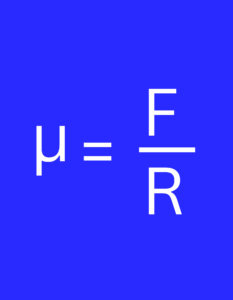
The coefficient of friction is defined as the ratio of the frictional force resisting motion to the normal force pressing the surfaces together:
μ=FfrictionFnormal\mu = \frac{F_\text{friction}}{F_\text{normal}}μ=FnormalFfriction
Where:
- μ = coefficient of friction (dimensionless)
- F_friction = force opposing motion (Newtons, N)
- F_normal = perpendicular force between the surfaces (Newtons, N)
A higher coefficient of friction indicates greater resistance to sliding, while a lower coefficient signifies smoother motion. This simple ratio provides engineers and scientists with a quantitative tool to evaluate and optimize surface interactions in multiple contexts.
Types of Friction and Their Coefficient
1. Static Friction (μ_s)
Static friction occurs between two surfaces at rest relative to each other. It determines the amount of force required to initiate motion. Static friction is generally higher than kinetic friction because it must overcome the microscopic interlocking of surface asperities before sliding can begin. Examples include pushing a stationary car or resisting movement in machinery parts at rest.
2. Kinetic (Sliding) Friction (μ_k)
Kinetic friction occurs when two surfaces slide past each other. It is usually lower than static friction and remains relatively constant once motion starts. Kinetic friction plays a significant role in processes like conveyor belt motion, sliding doors, or machining operations.
3. Rolling Friction
Rolling friction is the resistance encountered when a wheel, ball, or cylinder rolls over a surface. This friction is much smaller than sliding friction and is expressed as μ_r. It is relevant in the design of wheels, bearings, and rollers.
4. Fluid Friction (Viscous Friction)
Fluid friction occurs when an object moves through a liquid or gas. Unlike solid friction, viscous friction depends on the viscosity of the fluid and the surface area in contact. Applications include ships moving through water, air resistance on vehicles, and fluid flow in pipelines.
Factors Affecting the Coefficient of Friction
Several factors influence the coefficient of friction between surfaces:
- Surface Roughness: Smoother surfaces tend to have lower friction, while rough surfaces interlock more and increase μ.
- Material Type: Different materials exhibit varying frictional properties. Metals, polymers, rubber, and composites respond differently to applied forces.
- Temperature: Friction can increase or decrease with temperature. For example, rubber may soften under heat, reducing its coefficient.
- Lubrication: Oils, greases, and fluoropolymer coatings like PTFE drastically reduce μ by creating a slippery interface.
- Normal Force: Although μ is theoretically independent of normal force, extreme pressures can slightly alter the frictional behavior.
Coefficient of Friction in Common Materials
| Material Pair | Static μ | Kinetic μ |
| Steel on Steel | 0.74 | 0.57 |
| Rubber on Concrete | 1.0 | 0.8 |
| PTFE on Steel | 0.04 | 0.04 |
| Wood on Wood | 0.5 | 0.3 |
PTFE demonstrates an extremely low coefficient of friction, making it ideal for non-stick coatings, reducing wear, and improving energy efficiency in mechanical systems.
Applications of Coefficient of Friction
Mechanical Engineering
- Designing bearings, gears, brakes, and clutches to ensure efficient force transfer.
- Optimizing power transmission in industrial machines.
- Reducing wear and extending component life in mechanical systems.
Automotive Industry
- Tire traction analysis for safe vehicle handling on roads.
- Brake system design for controlled stopping distances.
- Evaluating clutch performance and drivetrain efficiency.
Industrial Machinery
- Minimizing wear and energy consumption in moving components.
- Selecting lubricants and coatings to prolong equipment longevity.
- Controlling friction to improve production speed and reduce maintenance.
Daily Life Applications
- Non-stick cookware uses PTFE to prevent sticking and simplify cleaning.
- Sports equipment such as skis, shoes, and gym machinery depend on friction optimization.
- Conveyor belts and roller systems require controlled friction for smooth operation.
Methods to Reduce or Control Friction
- Lubrication: Oils, greases, and synthetic lubricants decrease friction by creating a thin fluid layer between surfaces.
- Surface Treatments: Polishing, coating with PTFE, or applying anti-friction films can reduce resistance.
- Material Selection: Choosing materials with inherently low or high μ depending on the desired performance.
- Environmental Control: Adjusting moisture, temperature, and cleanliness can influence frictional behavior.
Practical Importance
Understanding and managing the coefficient of friction is essential for designing efficient mechanical systems, improving safety, and enhancing product longevity. Low-friction materials like PTFE allow engineers to develop high-performance devices, from medical implants to industrial machinery, while high-friction materials are vital for stability, traction, and grip in tires, footwear, and braking systems.
Conclusion
The coefficient of friction is a critical parameter that quantifies the resistance between surfaces. By understanding μ, engineers and scientists can optimize efficiency, reduce wear, and ensure safety across diverse applications. Materials such as PTFE illustrate how low-friction solutions improve performance and simplify daily life. Friction, while sometimes undesirable, is indispensable in many technological and natural systems, making the study of its coefficient vital for innovation and practical design.
Frequently Asked Questions (FAQs)
What is the coefficient of friction?
It is the ratio of the frictional force resisting motion to the normal force pressing two surfaces together.
What is the difference between static and kinetic friction?
Static friction resists motion at rest and is usually higher. Kinetic friction occurs during sliding and is lower.
How can friction be reduced?
Friction can be reduced with lubrication, surface coatings, polishing, or materials like PTFE that have inherently low μ.
Why is PTFE used in non-stick cookware?
PTFE has an extremely low coefficient of friction (~0.04), allowing food to release easily and surfaces to remain smooth.
Does temperature affect the coefficient of friction?
Yes, friction may increase or decrease depending on temperature and material properties.
Can friction ever be desirable?
Absolutely. Friction is essential for tire traction, brakes, gripping tools, and stability in mechanical systems.